
More choice, more options – discover the full range.
Precious Metal Catalysts for Laboratories
High-performance precious metal catalysts from ChemPUR for demanding reactions in homogeneous catalysis or industrial research applications.
Catalysis for Research
Precious Metal Catalysts at ChemPur
Precious metal catalysts are central building blocks of modern synthesis and development processes. ChemPur offers a broad portfolio for research, fine chemicals, and industry – ranging from homogeneous to heterogeneous systems. Our solutions support precise reaction control, high selectivity, and reproducible results. With years of experience, we support projects from the laboratory phase through to application.
Suitable Catalysts
Regardless of the catalyst type, we provide individual consultation to find the optimal solution for your application.
Discover our entire product range
Quickly find the right solution from our selection of over 4,000 metals, elements, and specialty chemicals.
Frequently Asked Questions
Our FAQs provide you with a quick overview of important topics related to our product range. If you have any further questions, we will of course also be happy to assist you personally.

Purchasing / Sales
We will be happy to advise you individually
What are precious metal catalysts?
Precious metal catalysts are chemical substances that accelerate reactions without being consumed themselves. They are based on metals such as palladium, platinum, ruthenium, or rhodium, which offer particularly active surfaces or reaction centers due to their electronic structure. In practice, they enable targeted control of reactions, improve yields, and reduce by-products.
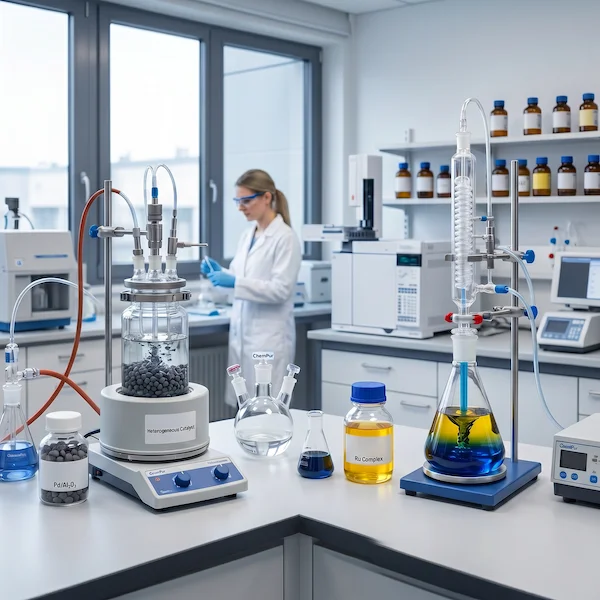
They are indispensable in research and development, as they make complex synthesis processes efficient and reproducible. Depending on their structure, they are used as homogeneous or heterogeneous catalysts. While homogeneous systems act in solution, heterogeneous catalysts usually work on solid supports. We provide these precious metal catalysts in high purity to ensure reliable and consistent results in the laboratory and in industrial processes. By combining material expertise, consultation, and a broad portfolio, ChemPur supports users in selecting suitable systems for specific applications.
Which catalysts does ChemPur offer?
ChemPur offers a broad portfolio of precious metal catalysts specifically designed for requirements in research, development, and industry. These include both homogeneous and heterogeneous systems covering different reaction conditions and objectives.
The range specifically includes catalysts based on palladium, platinum, ruthenium, and rhodium. Due to their catalytic properties, these metals are used in numerous applications – from organic synthesis to gas purification. Additionally, ChemPur offers specialized catalyst solutions for environmental technology and process chemistry. A central advantage is the combination of standard products and individual solutions. In addition to the regular delivery program, ChemPur also supports project-specific requirements and custom fabrications. Customers benefit from technical consultation and a global network for reliable supply.
What are heterogeneous catalysts?
Heterogeneous catalysts are systems in which the catalyst and the reactants exist in different phases – typically solid and liquid or solid and gaseous. The catalytically active precious metals are usually fixed on support materials such as activated carbon or aluminum oxide.
This design enables easy separation of the catalyst from the reaction mixture, which is particularly advantageous in technical processes and for repeated use. Furthermore, heterogeneous systems often offer high stability under demanding conditions. At ChemPUR, you can obtain heterogeneous precious metal catalysts for various applications, including process development and gas purification. Additionally, support materials and geometries can be adapted to specific requirements. This allows reaction conditions to be specifically optimized and efficiency potentials to be utilized.
What are homogeneous catalysts?
Homogeneous catalysts exist completely in the same phase as the reaction medium, predominantly dissolved in a liquid. These are precious metal compounds complexed with organic ligands that possess a defined molecular structure.
This property enables particularly precise control of reaction mechanisms. Homogeneous catalysts are characterized by high selectivity and uniform distribution in the reaction space. They are therefore particularly suitable for demanding syntheses in fine chemicals and research. We offer a variety of homogeneous precious metal catalysts for different applications. You can perform targeted searches via the product catalog or, of course, contact us directly so that we can support you in the efficient planning and implementation of your research projects.
Which precious metals are used?
Metals with high catalytic activity and stability are primarily used in precious metal catalysts. The most important include:
- Palladium,
- Platinum,
- Ruthenium
- and Rhodium.
These elements possess specific electronic properties that make them particularly suitable for catalytic processes. Their areas of application differ significantly depending on the use case. Palladium is frequently used in coupling reactions, while platinum plays an important role in oxidation and reduction processes. Ruthenium and rhodium are used in specialized syntheses and selective reactions.
ChemPUR offers these precious metals in various catalytic systems, both as homogeneous complexes and in heterogeneous form on supports. This allows you to specifically select the appropriate metal for your specific requirements and achieve optimal reaction conditions.
What are palladium catalysts used for?
Palladium catalysts are among the most important tools in modern organic chemistry. They are used particularly for coupling reactions, where complex molecular structures can be efficiently built. These include, among others, C-C and C-N bond formations.
These properties make palladium indispensable for applications in pharmaceutical research, fine chemicals, and material development. The high activity and selectivity enable precise syntheses under comparatively mild reaction conditions. We provide palladium catalysts in different forms, adapted to various reaction systems. Customers benefit from a broad range as well as the possibility to implement specific requirements. This supports the reliable execution of demanding synthesis processes.
What applications do platinum catalysts have?
Platinum catalysts are used in a variety of chemical processes, primarily in oxidation and reduction reactions. They play a central role in gas purification, the chemical industry, and material research. Due to their high stability and resistance to extreme conditions, they are particularly suitable for demanding processes. These include applications in exhaust gas purification systems or the production of chemical intermediates. At ChemPUR, we offer platinum catalysts for different areas of application, both as part of heterogeneous systems and in specialized forms for research applications, allowing you to make a targeted selection for individual requirements and process conditions.